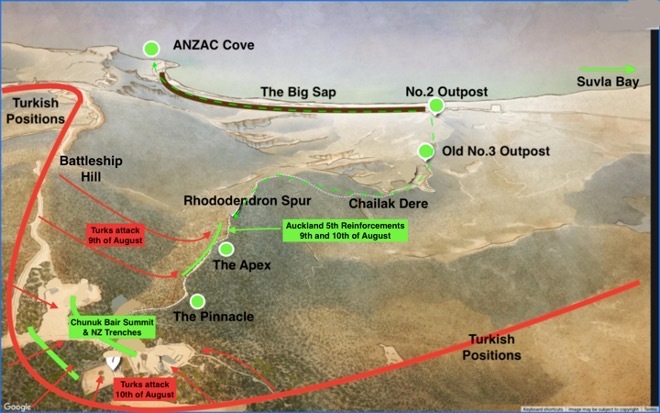
The situation on Gallipoli when the 5th Reinforcements arrived was complex, confused and above all, deadly.
It will be valuable to give context of the maelstrom that George and the Reinforcements found themselves in when they landed on ANZAC on the 8th of August 1915, and why George's lost his first diary.
By July 1915, the ANZAC’s could move no further inland onto the peninsular, but conversely, the Turks could not push them back into the sea. It was a stalemate ... so the British hatched a plan.
Sari Bair is name of the mountain range looking down on ANZAC cove where the Kiwi’s and Aussies were trapped, surrounded by the Turkish Army. It was determined that one of the mountain peaks in the Sari Bair range called “Chunuk Bair”, a summit with long sloping approaches, was an achievable goal for the ANZAC’s to take from the Turks and give them a new advantage of elevation, and break the four month stalemate that had descended on Gallipoli.
The Sari Bair campaign began on the 6th August 1915, and would include the famous Australian battles such as Lone Pine and The Nek (the battle in which Mel Gibson starred in the movie ‘Gallipoli’, which gives a great account of that part the Sari Bair campaign). Thousands of English troops would also be landed at the same time further north at Suvla Bay, and a new English/French advance down south at Helles would also be attempted.
For the New Zealanders themselves, their contribution would be to assault the Chunuk Bair summit, and it’s surrounds. The Chunuk Bair summit was the key geographical point of the whole “August Offensive”, with the Australian & English battles acting as diversions to draw Turkish fighters away from Chunuk Bair. The great mountain had to be won and held by the New Zealanders. The stakes were high, as this was the last throw of the dice for the British & French armies on Gallipoli.
History tells us that the New Zealand Wellington Infantry Battalion at great cost and sacrifice captured Chunuk Bair on the 8th of August as planned, and was bitterly holding on to the narrow summit against savage Turkish counter offensives. By now the Turks had realised that Chunuk Bair was the key to the British plans and it had to be taken back at all costs. The other NZ Battalions (Auckland, Otago, Canterbury, and Mounted Rifles) & some English Battalions were holding the approaches up to the summit, and all were exposed to artillery and gunfire from Turks on the surrounding Sari Bair summits. The climax of the Gallipoli campaign was now focused on Chunuk Bair ... and George was heading right there.
The capture of Chunuk Bair on the 8th of August was the very day that George and his 5th Reinforcements landed at ANZAC cove. George and the 5th Reinforcements were sent straight up to Chunuk Bair as support fighters and labourers on the approaches to the narrow summit, and directly into the most desperate and savage fighting of the whole Gallipoli campaign.
A senior officer in the NZEF “Main Body”, Colonel Fred Waite, witnessed the 5th Reinforcements arrival and subsequent injection directly into the battle of Chunuk Bair and later wrote “If ever mortals were projected into a hell of torture and suffering, it was the men of the 5th Reinforcements. Coming straight from the transports, they arrived at No. 2 Post on August 8, and were summarily introduced to modern war. Hundreds of wounded had been carried down from the bloody slopes of Chunuk and were laid in rows in the neighbourhood of No. 2 Post, in readiness to be carried along the Big Sap, and so to the piers as soon as it was dark. These men of the 5th Reinforcements had served little apprenticeship to active service; but they had heard of the casualties of the landing at Anzac and Helles, and some have written that at first they were of the impression that these rows of wounded men were an everyday occurrence! In a sort of nightmare, not knowing whither they were going, or even the name of the dere they traversed, these men dived into the trenches on Chunuk Bair and found themselves among Wellington and Otago Infantry, Auckland and Wellington Mounted Rifles—the heroic band of brothers clinging to Chunuk and prepared to die there. A great proportion did die there; but they held Chunuk! Into this company of heroes stumbled the men of the Fifths. They were greeted with “dig for your lives for dawn is not far away, and if you haven't got cover by then, you're dead men!”
The path that the Auckland 5th Reinforcements took is well described in the men's diaries and letters. They landed on ANZAC Cove in the early hours of August 8th, proceeded north in the safety of the Big Sap to No.2 Outpost, then turned inland to arrive at the foothold of the Sari Bair at Old No.3 Outpost at around dawn on the 8th. They rested here (and doing various jobs and generally looking around) for the rest of the 8th and the morning of the 9th. On the afternoon of the 9th of August, the NZ 5th Reinforcements joined a train of solders from the British New Army on their long winding track up to Chunk Bair. Not long after leaving Old No.3 Outpost, they would need to travel through an open pass that was throughly covered by Turkish artillery, and where many were killed or wounded here. Once through the pass, they would enter the relative safety of Chailak Dere (Dere means a ravine in Turkish), winding their way up the side of lower reaches of Chunuk Bair and enter out on top of a ridge known as Rhododendron Spur (also called Rhododendron Ridge and Canterbury Ridge) on the early evening of the 9th.
Once on top of the Rhododendron Spur, most of the Auckland 5th Reinforcements were put to work improving the track and trenches just short of the Apex. By this time, there were masses of trenches on both sides of The Spur, providing cover for the supporting NZ and English troops.
The battle for the summit was till raging ... only 300meters ahead, but there was little or no room for extra troops on the summit itself, so most were gathered around the base and approaches to the top.
A sudden attack by the Turks on the 9th, coming down from Battleship Hill through the gully and heading up on to Rhododendron Spur saw all the Auckland 5th Reinforcements throw down any shovels they were using and join the battle. The Aucklanders forced them back.
As George would later explain in the opening of his new “second” diary … “25th October 1915 - Alexandria, Egypt - Starting new diary. Lost old one with tunic, badges & etc when I got wounded on August 9th.”. George’s wound on the 9th of August was from an exploding Turkish artillery shell, as he made his way up to fighting on Chunuk Bair. After much research, there is still no definitive evidence to say exactly where on that climb George was hit. It’s possibly anywhere from their overnight resting place at Outpost #3, or during the dash across the open pass after just leaving Outpost #3 and before entering Chailak Dere, or once up on Rhododendron Spur. All three supporting diaries mention the never ending Turkish artillery killing and wounding men of Auckland’s 5th Reinforcements in all three areas. As Lt McComish wrote in his diary about the 9th of August "All the time we were having men killed or wounded, there being no escape from the shrapnel. "
We do know that same shell severely wounded & ultimately killed his good mate from Tuakau, Pte Harold Smith (12/2474) who died of his wounds once evacuated back to England on the 8th of December 1915. Clearly this artillery explosion was significant enough for George to be pulled off the line on the 9th of August for a few days. Was it the wound or the impact it had on Harold Smith, we'll never know? There is a very real possibility that same shell killed Eric Knight (a newspaper article mentions that the shell killed two of George's mates) ... but we'll never know for certain.
George’s wound on the 9th of August 1915 wasn’t bad enough to see him evacuated and would see him remain in the trenches on Rhododendron Spur for three weeks, but after a “three day rest”.
History tell us that the Chunuk Bair summit was captured at a horrendous cost by Kiwi soldiers on the 8th of August, but subsequently lost to the Turks on the 10th of August, after the exhausted and decimated New Zealanders had been relived off the summit by fresh yet inexperienced English troops on the 9th of August. These English troop panicked on the 10th when massed waves of Turks attacked, and the English troop abandoned the summit. It was the Aucklander’s who grimly held on further down at the Apex on the 10th, that steamed the Turkish tide and forced them back to the summit. The NZ’ers would hold the Apex and Rhododendron Spur for a further 4 months right up until the Gallipoli evacuation in December 1915. The great Sari Bair plan had failed.
Georges wound would eventually turn in the gruesomely unhygienic conditions of Gallipoli, and see him sent back to Egypt on the 1st of September 1915 for treatment. It was back here in Egypt that he started a new diary (the second diary) on the 25th of October 1915.
Just before George was evacuated off Gallipoli on the 1st of September back to Egypt, he wrote the following letter home to his mother on the 29th of August. This is the first documentation we have from George after the landing.
Dardanelles
29/8/1915
Dear Mother
Just a few lines from the trenches to let you know that I am well and having a strenuous time. I sent you an Active Service post card a while ago to let you know I was still kicking and I suppose you will get it about a week before this.
Well Mother, writing is a very difficult problem here because we can’t tell you anything that is doing on account of all the letters being censored.
I could not give you any idea what like it is here Mother, because you could not be able to form the faintest idea. In fact, only the ones that are here and been here know what it is like.
Alex Craig and Bill Mack are both away back in some of the hospitals or rest camps. I think Alex took crook a day or two after we landed here and Bill shortly after. A terrible lot of our fellows are crook and away, dysentery the main trouble. I did not hear what it was with Bill & Alex, but I think that was the matter.
I have lost over a dozen of my mates killed and wounded. In fact, I have lost four of the finest mates one would wish to be with. You remember me telling you about the mate that stopped with me in the hut at Tuakau, Mother, well he was killed the second day we reached here. I was wounded with the same shell. I got it slightly on the kneecap and ankle, but was alright again after three days rest and back at it again.
Tommy Gilmour is in the same trench as me here, he is in the machine gun section. We had a great talk over old Goodwood dances yesterday “Sketching”, best laugh I’ve had for a while.
I have seen some terrible sights here, Mother, but I am quite used to it now and never think about it.
Tommy has just come back from the hospital, he was away crook. I think he said 13 weeks.
Duncan & Tommy McGregor are here, I seen them both. They are quite well, also Bruce McLeod. I haven’t seen my Clinton cobbers yet, one of them was wounded the day we reached here, but I had the ill luck to pass right past him and didn’t know he was there among the wounded, he is one of the hospitals in Egypt now.
We have got scattered a good bit since landing and I haven’t been among the Otago lot, but some of them were telling me that Joe Carnegie is still going strong.
The weather here is terrific hot through the day and talk about flies, well Mother when you cook your meal and sit down to eat it that is the end of you, they simply take command and run the show, the little house flies you know, that get on the pictures at home there and have Doll & Tina Christmas cleaning every now and again.
I am not going say anything about the tucker here Mother, but I suppose its right enough under the circumstances. The general opinion here is that the war here wont last much longer and I don’t think it will either, the Turks are getting it very hot. They are real good fair fighters the Turks and any tales about their barbarity wants to be taken with salt, perhaps an isolated case may have happened but all the chaps that have been here from the first say they haven’t known of anything of that kind happening. The Turks are here at us at the point of the revolver by the Germans.
What sort of weather are you having in NZ, Mother, winter about over I suppose. I haven’t got any letters since I left Trentham and I am looking forward to a big mail the next lot we get. We had the luck to loose our first mail here, the parcel boat had an accident and went down with all the mail, that is as far as I was told what happened to it.
Tell the Gordons I was asking for them Mother, tell them there is plenty of dancing here but you dance to the music of the shrapnel and bullets. I am liking it tip top and getting use to the heat now.
Well Mother I will stop now and hope this finds you all well. Tell Doll, Alex & Tina and yourself to keep the pen going because it’s the only news we get here. Otago witnesses and rag would be very acceptable, we go mad for something to read here.
Your affect son.
George.
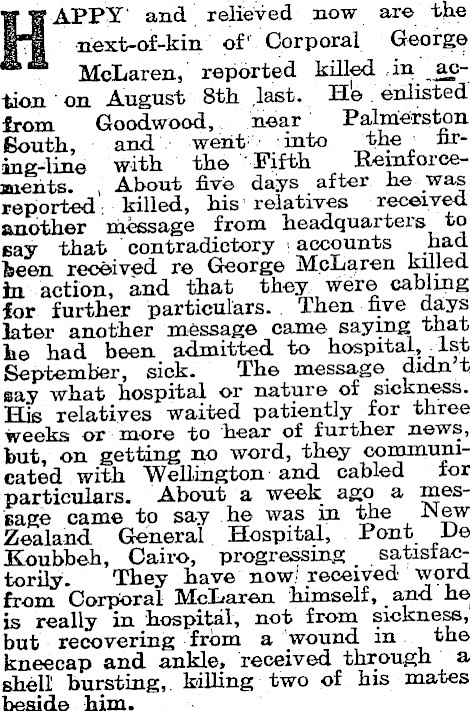
George's letter on the 28th of August would not beat home the erroneous news that George had actually been killed not wounded on Gallipoli on the 8th of August. It is understandable, it was a chaotic few days that saw +900 NZ deaths alone between the 6th and 12th of August. The grim news reached Goodwood and poor Isabella who had the awful task of announcing George's highly exaggerated death.
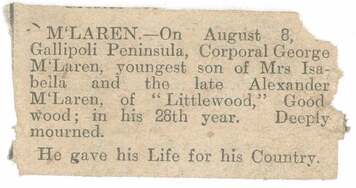
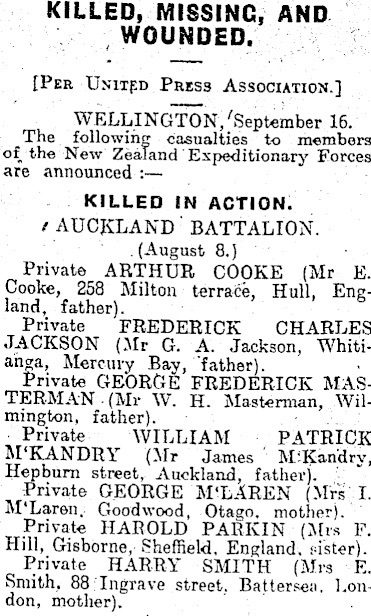
Thankfully it was only a a week before the correct news arrived home that George had indeed been only wounded. The record was corrected, but one wonders the affect on poor Isabella and the family.
George’s extended time away from Gallipoli recuperating back in Egypt (1st of September till the 10th of November) happened to coincide with most NZ troops being pulled off Gallipoli for a rest and refit period on the nearby Greek island of Lemnos. George's return to Gallipoli also coincided with the return of all NZ troops back to ANZAC on the 10th of November.
We can now start using George's new diary that started on the 25th of October in Alexandria Egypt.